Sewage Treatment Plant Manufacturer In Faridabad: Why Groundwater Stress Makes Reuse the Real Priority
Faridabad's groundwater extraction sits at roughly 180.89 percent of annual recharge, according to a Central Ground Water Board assessment reported in the state press, nearly double what's considered sustainable. That statistic usually comes up in industrial conversations, but it applies just as directly to residential societies, schools, and commercial campuses. Every building generating sewage without a plan to treat and reuse it is missing a genuine opportunity to ease pressure on a water table that's already being drawn down faster than nature can refill it.
Why This Changes the Sewage Treatment Conversation
Most property owners think about sewage treatment purely through a compliance lens, install a plant, satisfy the pollution board, move on. Given how strained the region's groundwater actually is, that framing misses the bigger opportunity. A properly designed Sewage Treatment Plant Manufacturer In Faridabad doesn't just help a property avoid penalties, it directly reduces how much that property needs to pull from an aquifer that's already under serious stress.
The Broader Community Impact Worth Considering
There's a dimension here beyond an individual property's own water bill. When enough buildings in a sector treat their own sewage and reuse it responsibly, the cumulative reduction in borewell dependence genuinely eases pressure on the shared aquifer that every property, and every neighbor, ultimately relies on. A single society's decision might feel small in isolation, but repeated across a growing residential sector, this kind of individual responsibility adds up to a meaningful collective effect.
Why Municipal Infrastructure Can't Be the Fallback Plan
Faridabad's civic sewage network has expanded, but not always fast enough to match the pace of new residential sectors and commercial campuses coming online. Many newer developments still lean on tankers and informal disposal arrangements rather than a dependable centralized system built for today's actual volume. Given the same underlying water stress driving the region's groundwater crisis, relying on an overstretched municipal system as a backup plan is increasingly risky rather than reassuring.
What Delayed Planning Actually Costs a Property
Developers who leave sewage treatment planning until construction is nearly finished routinely end up compromising on land allocation, technology choice, or approval timelines. Properties that push off compliance altogether tend to face a predictable sequence, formal notices from pollution authorities first, complications securing occupancy certificates next, and in serious cases, restrictions on further development until proper treatment is demonstrated.
Why Retrofitting Costs More Than Planning Ahead
A property that treats sewage infrastructure as an afterthought, squeezed into whatever space remains after everything else is built, almost always ends up with a smaller, less optimally positioned plant than one planned from the start. Retrofitting later, once a site is fully constructed and occupied, means working around live infrastructure and accepting compromises that a bit of early planning would have avoided entirely.
Why Reuse Deserves Priority Over Simple Discharge
Given Faridabad's groundwater situation, a property discharging treated sewage without any reuse plan is leaving genuine value on the table. Treated water can serve several practical purposes on a well designed system:
1) Landscaping and garden irrigation across the property
2) Flushing systems throughout residential or commercial towers
3) General non potable applications that don't need fresh water quality
4) Cooling tower makeup for commercial developments, where relevant
Every litre redirected this way is a litre that doesn't need to come from a borewell drawing on an aquifer already being extracted at nearly double its sustainable rate.
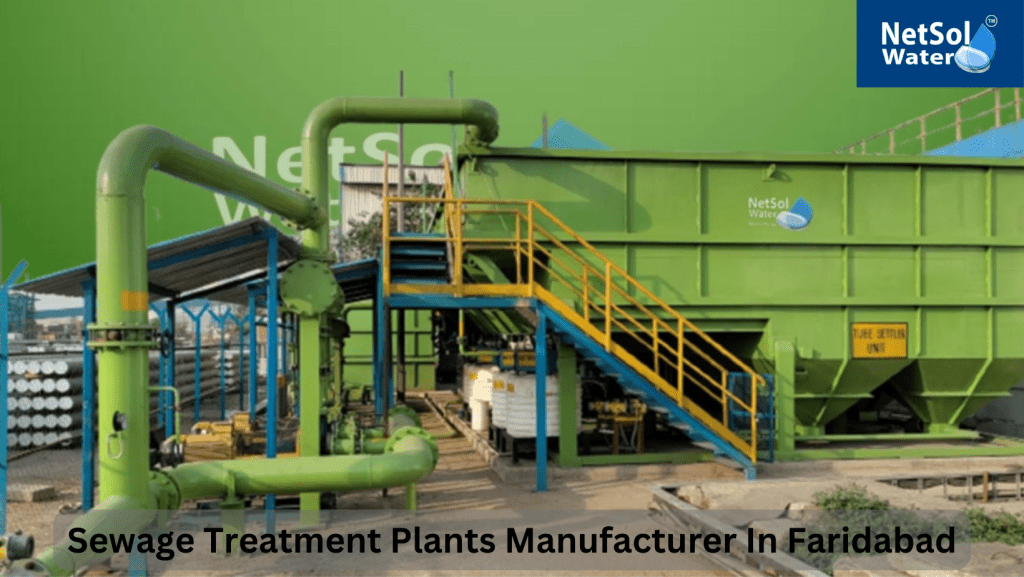
Quantifying What Reuse Actually Means for a Property
A residential society that redirects treated water toward flushing and landscaping can offset a genuinely meaningful share of its total daily water demand, often enough to noticeably reduce dependence on both borewell extraction and external tanker supply across a full year. Given how tightly stretched the region's groundwater already is, this isn't a marginal benefit, it's one of the more direct ways an individual property can meaningfully reduce its footprint on a shared, depleting resource.
Matching Technology to How a Property Actually Functions
A residential society experiences fairly steady flow through the day, while a school or commercial campus deals with sharp spikes tied to specific hours instead. A capable manufacturer designs around this distinction directly rather than applying identical technology regardless of the property type. Getting this match wrong means either a system straining constantly under peak load, or one running needlessly expensive for a facility that never generates the volume it was sized for.
Space Planning for Faridabad's Denser Developments
Not every property has generous land available for a large treatment plant, particularly in denser residential sectors. Compact and modular systems have become the practical answer, delivering full treatment capability without consuming space that could otherwise serve residents or shared amenities. Underground installations have gained popularity too, though they need careful upfront planning around maintenance access so routine servicing doesn't become unnecessarily difficult for technicians later.
What Genuinely Separates a Trustworthy Manufacturer
A handful of questions consistently separate manufacturers worth trusting from those likely to leave a property dealing with recurring headaches. Does the manufacturer conduct a proper site assessment and flow calculation before recommending any technology? What does their maintenance support actually cover once installation wraps up? How quickly do they respond when something needs attention? Can they point to documented experience with similar developments specifically within Faridabad?
Why Ongoing Support Matters More Than the Installation Itself
Building and commissioning the plant is genuinely just the beginning. What happens across the following fifteen or twenty years determines whether a property actually benefits from its investment. Regular monitoring, sludge management, and periodic servicing all need consistent attention, and a manufacturer who stays genuinely involved after handover makes a measurable difference to how reliably the system performs, and how much water it actually helps recover over its operating life.
Building Toward Genuine Water Security, Not Just Compliance
Faridabad's groundwater numbers make the stakes clear. A resource being drawn down at nearly double a sustainable rate doesn't leave much room for properties to treat sewage as a box ticking exercise. Commercial RO Plant designs sewage treatment plant for residential societies, commercial complexes, and institutional campuses across Faridabad, built around genuine reuse planning and backed by the ongoing support that keeps a system performing years after installation. If your property needs a new STP, or an existing one isn't delivering the reuse value it should, Commercial RO Plant is a practical place to start that conversation.


Comments
Post a Comment