Commercial RO Plant Manufacturer In Gurgaon: A No-Nonsense Guide For Business Owners
Commercial RO Plant Manufacturer In Gurgaon: A No-Nonsense Guide For Business Owners
Gurgaon looks like a city that has everything figured out. Glass towers, corporate campuses, five-star hotels, world-class hospitals. But underneath all of that infrastructure sits a water problem that quietly costs businesses crores every year.
If you are running any kind of commercial operation in Gurgaon and you have not seriously looked at your water quality, this guide is worth your time. And if you are already searching for a reliable commercial RO plant manufacturer in Gurgaon, read this before you make any calls.
What Is Actually In Gurgaon's Water
Most business owners assume their water is fine until a machine breaks down or a product fails a test. By then the damage is done.
Gurgaon's groundwater situation is genuinely difficult. The water table has been dropping for years due to rapid urbanisation and overextraction. What remains is increasingly concentrated with contaminants that standard filtration cannot handle.
Here is what water testing in Gurgaon typically reveals:
1) TDS levels between 800 and 2500 PPM across many sectors, well above the safe drinking limit of 500 PPM
2) Extreme hardness that leaves visible scale on equipment, fixtures, and pipelines within months
3) Elevated fluoride in groundwater pockets across several areas of the city
4) Iron and manganese that cause staining, bad taste, and rapid membrane fouling in untreated systems
5) Microbial contamination in areas dependent on older municipal distribution lines
HUDA supply covers planned sectors but fluctuates significantly in pressure and quality across seasons. Most commercial establishments supplement it with borewells, and borewell water in Gurgaon is among the hardest to treat in the entire NCR region.
This is not a background detail. It is the reason why choosing the right commercial RO plant manufacturer in Gurgaon directly affects how much your water treatment system actually costs you to run over time.
How A Commercial RO Plant Works And Why Most Buyers Focus On The Wrong Thing
The core technology is straightforward. Water is forced through a semi-permeable membrane under pressure. The membrane blocks dissolved salts, heavy metals, bacteria, and viruses. Purified water passes through. Concentrated reject water is discharged separately.
What most buyers focus on is the membrane. What actually determines whether the system performs well for five or eight years is everything built around it.
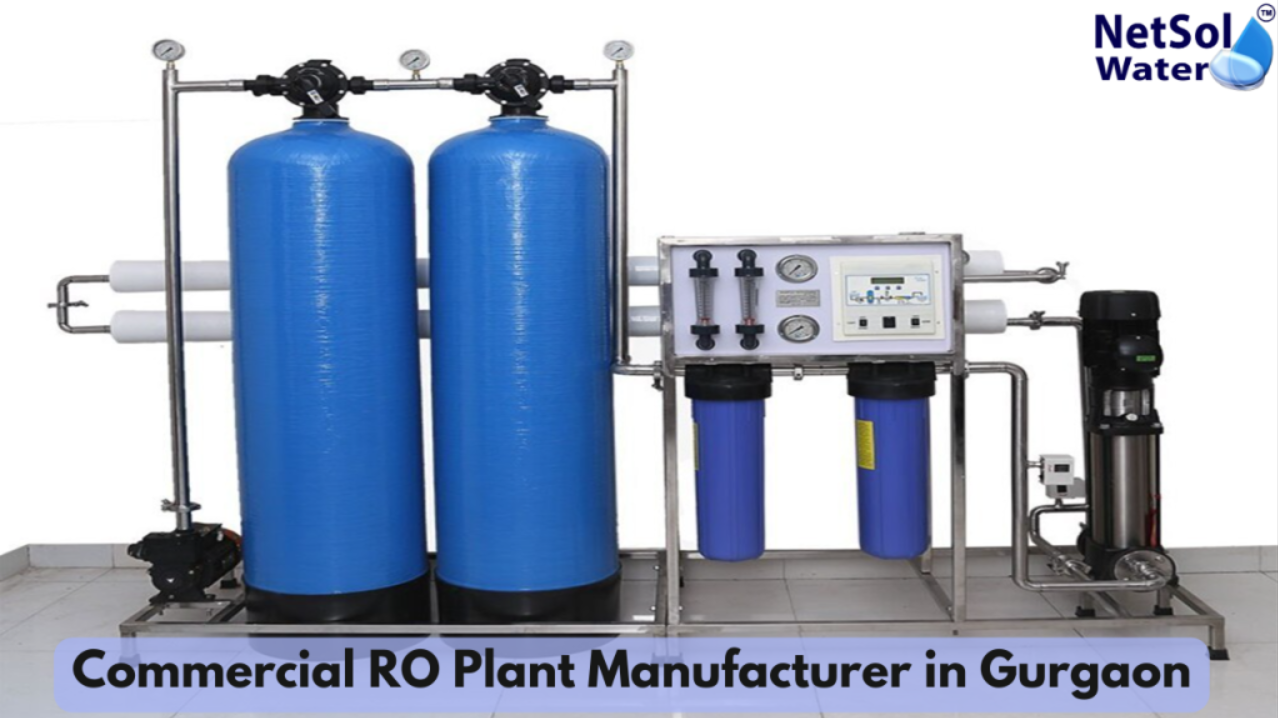
A properly designed commercial RO plant includes several stages working together.
A) Pre-treatment removes suspended solids, iron, manganese, and chlorine before water reaches the membrane. Skipping or undersizing pre-treatment is the single most common reason membranes foul quickly in Gurgaon, where source water is particularly aggressive.
B) The high-pressure pump must be sized to your source water TDS and your required flow rate. An undersized pump cannot generate the pressure needed for adequate recovery. An oversized pump wastes energy and stresses the system.
C) Membrane configuration determines how much purified water you recover from each litre of feed water. In high-TDS Gurgaon groundwater, recovery rates typically run between 60 and 70 percent without a well-designed system. Better design pushes that higher and reduces your water and operating costs.
D) Post-treatment adjusts pH and mineral content where needed, particularly for drinking water applications or sensitive process water uses.
E) Automated controls manage flush cycles, monitor pressure and TDS, and trigger alerts or safe shutdowns when parameters drift outside acceptable ranges.
A commercial RO plant manufacturer in Gurgaon who sells you a standard assembled unit without engineering the system to your specific water chemistry is setting you up for poor recovery rates, rapid membrane degradation, and high operating costs that compound over years.
Every Type Of Business In Gurgaon That Needs This
A) Corporate Offices And IT Campuses
Large office buildings serving hundreds or thousands of employees every day cannot sustainably rely on packaged drinking water. The cost is high, the logistics are constant, and the plastic waste is significant. A centralised commercial RO plant provides clean water at scale for a fraction of the ongoing cost.
B) Hospitals And Diagnostic Centres
Medical water is not just about taste. Sterilisation, laboratory analysis, CSSD operations, and patient care all require water that meets defined microbiological and chemical standards. A commercial RO plant manufacturer in Gurgaon working with healthcare clients must understand what medical-grade water compliance actually means, not just provide general purification.
C) Hotels And Service Apartments
Hard water in a hotel shows up everywhere guests look and touch. Scale on shower heads and taps. Film on glassware. Linen that looks grey after a few washes. Appliances that fail ahead of schedule. RO-treated water solves all of this and protects both the property and the reviews.
D) Restaurants, Cafes, And Cloud Kitchens
FSSAI requires food businesses to use water meeting defined purity standards. Beyond compliance, water quality directly affects the taste of food and beverages. A coffee or a soup made with high-TDS water tastes different. For quality-conscious food businesses in Gurgaon, treated water is a product quality decision, not just a regulatory one.
E) Schools, Colleges, And Coaching Centres
Institutions serving large student populations need safe, consistent drinking water without the cost and logistics of bottled water. A well-designed commercial RO system serves an entire campus reliably for years.
F) Manufacturing Units In IMT Manesar And Udyog Vihar
Process water quality affects production consistency in most manufacturing operations. Hard and high-TDS water causes scaling in cooling systems, corrosion in pipelines, and inconsistency in any process where water contacts the product. A commercial RO plant manufacturer in Gurgaon with manufacturing sector experience understands these requirements specifically.
How To Tell A Serious Manufacturer From One Who Is Just Selling Boxes
This section will save you a bad decision.
1) They Insist On Testing Your Water Before Quoting
This is the clearest signal of a manufacturer who actually knows what they are doing. Your source water has a specific chemistry that determines what pre-treatment you need, what membranes will work, what recovery rate is achievable, and therefore what the system should cost. A commercial RO plant manufacturer in Gurgaon who quotes based on capacity alone is designing blind and you will pay for it in operating costs.
2) They Ask About Your Application, Not Just Your Volume
A hospital water system and a restaurant water system have different design requirements, different output quality targets, and in some cases different regulatory documentation requirements. A manufacturer who treats them identically does not understand either of them. Ask how they approach your specific industry and listen carefully to the answer.
3) They Can Name Every Component They Use
Ask for the membrane brand and model. Ask for the pump manufacturer. Ask whether vessels are FRP or stainless steel and what the pressure rating is. Ask what instrumentation is included. A manufacturer using quality components will answer every one of these questions specifically and confidently. Vague answers about components usually mean the components are generic or below specification.
4) They Have A Real After-Sales Structure
The system needs maintenance. Membranes degrade. Pre-filters need replacement. Pumps need periodic servicing. Ask specifically what the AMC covers, what the response time commitment is for breakdowns, whether they have service engineers based in Gurgaon, and how quickly spare parts can be sourced. A commercial RO plant manufacturer in Gurgaon with no local service presence is a risk that shows up the first time something needs attention.
5) Their References Match Your Scale And Industry
Ask for contacts at two or three completed projects similar to yours in size and sector. Call them. Ask whether the system performs as specified, whether installation was on time, and whether service support is reliable. A manufacturer confident in their work will give you references without hesitation.
Buying Mistakes Gurgaon Businesses Make Repeatedly
These patterns come up consistently and all of them are avoidable with the right information upfront.
A) Choosing the lowest quote without understanding what components are being used or what after-sales support is included
B) Sizing the plant for average daily demand without accounting for peak hours, which means the system cannot keep up when demand spikes
C) Not asking about reject water volume and drainage requirements, then discovering the site is not set up to handle the discharge
D) Assuming all commercial RO plants perform similarly regardless of design quality or source water conditions
E) Working with a local assembler who has no engineering team and no AMC capability, and finding that out only after installation
Getting The Capacity Calculation Right
Oversizing wastes capital. Undersizing means the plant cannot meet your peak demand. Neither outcome is acceptable.
Start with your actual total daily water consumption across all uses. Include drinking, cooking, process water, equipment washing, and any other application. Add 25 percent as a buffer for peak demand and system losses.
Divide the total daily requirement by the number of hours per day you plan to run the plant. That gives you the minimum litres-per-hour rating you need.
One more factor specific to Gurgaon: high-TDS borewell water typically means a reject ratio of 30 to 40 percent. That means for every 100 litres of feed water, you may get only 60 to 70 litres of purified output. Your feed water supply needs to account for this.
A corporate office consuming 10,000 litres of purified water per day and running the plant for 10 hours needs at least a 1000 LPH system. Factor in the reject ratio and you need to supply roughly 1400 to 1600 litres of feed water per hour.
A qualified commercial RO plant manufacturer in Gurgaon will run through this calculation with real numbers from your facility, not estimates.
Why Commercial RO Plant Is The Commercial RO Plant Manufacturer In Gurgaon Businesses Keep Coming Back To
Commercial RO Plant is an ISO certified commercial RO plant manufacturer and supplier with a strong delivery record across Gurgaon and the entire NCR region.
We start every engagement with a water analysis of your specific source. No assumptions, no standard packages sold on the basis of capacity alone. Every system is engineered to your water chemistry, your industry application, your site conditions, and your actual daily demand pattern.
We use verified, branded components with documented specifications and warranty terms. Our fabrication process is backed by ISO certification, which means there are defined quality checks at every stage of manufacturing, not just at the end.
Our Gurgaon service team handles AMC, scheduled maintenance, spare parts supply, and breakdown response. We do not hand this over to third parties. Our own engineers manage every service call so the quality of support is consistent and accountable.
We have delivered commercial RO plants across Gurgaon for healthcare facilities, hotel groups, corporate campuses, food businesses, educational institutions, and manufacturing operations. Each project was engineered specifically for the client, not assembled from a standard product range.
Contact Commercial RO Plant today for a free water analysis and site assessment for your Gurgaon facility.


Comments
Post a Comment