What You Need To Know Before Hiring An Industrial RO Plant Manufacturer ?
What You Need To Know Before Hiring An Industrial RO Plant Manufacturer ?
Most industries buy an RO plant once. They live with that decision for the next 10 to 15 years.
That is a long time to regret a bad choice.
This blog is not a product pitch. It is a practical guide for plant managers, procurement heads, and business owners who want to understand what they are buying, what questions to ask, and what actually separates a reliable industrial RO plant manufacturer from one that disappears after the sale.
Industries That Depend On Industrial RO Plants Every Single Day
Before we get into the technical side, it helps to understand how wide the use of industrial RO actually is.
1) Power plants use demineralized water for boiler feed to prevent scaling and corrosion
2) Pharmaceutical companies need ultra-pure water that meets WHO and pharmacopoeia standards
3) Textile and dyeing units need soft, low-TDS water to protect fabric and achieve consistent color output
4) Food and beverage manufacturers need water that meets food safety regulations as a direct ingredient
5) Steel and metal industries use treated water for cooling and surface processing
6) Chemical manufacturing plants use high-purity water to avoid unwanted reactions
7) Automobile and electronics manufacturing units need water for washing and rinsing without mineral residue
In each of these sectors, water quality is not a secondary concern. It is built into the process itself.
What An Industrial RO Plant Actually Looks Like At The System Level
If you have only seen small domestic or commercial RO units, an industrial setup will look very different.
A) Feed Water Intake And Pre-Treatment
Raw water enters the system first. Depending on the source, this could be borewell water, river water, municipal supply, or even partially treated effluent. The pre-treatment stage removes suspended particles, sediment, iron, and free chlorine before the water reaches the RO membrane.
A typical pre-treatment train includes a clarifier or settling tank, pressure sand filters, activated carbon filters, iron removal filters if needed, and antiscalant chemical dosing to prevent scaling on the membrane surface.
Skipping or underdesigning pre-treatment is one of the most common mistakes buyers allow manufacturers to make. The membrane pays the price.
B) The RO Membrane Stage
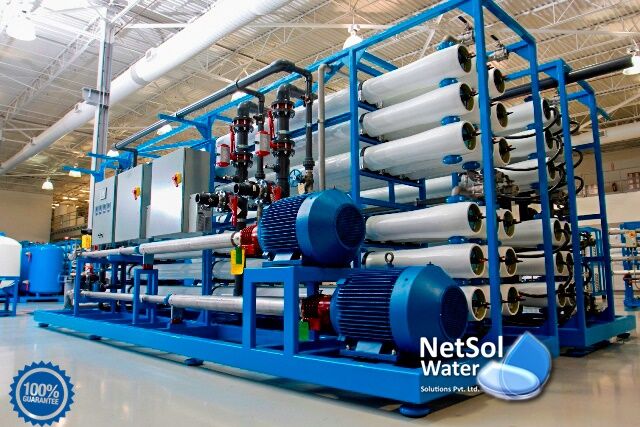
This is the core of the system. High-pressure pumps push pre-treated water through spiral-wound membranes. These membranes reject dissolved salts, heavy metals, nitrates, silica, bacteria, and most other contaminants.
Water that passes through the membrane is called permeate. Water that carries the rejected material away is called concentrate or reject.
Industrial systems are often designed in multiple passes. A two-pass system runs the permeate through a second set of membranes to achieve even higher purity. Pharmaceutical and electronics applications usually require this.
3) Post-Treatment And Polishing
Depending on the end use, the purified water may go through mixed bed deionizers, UV sterilizers, ozone treatment, or remineralization before storage and distribution.
4) Instrumentation And Automation
Any serious industrial RO plant manufacturer will integrate instrumentation into the system. Flow meters, pressure gauges, conductivity sensors, and TDS monitors allow operators to track performance in real time. Modern systems include SCADA or PLC-based automation so alerts trigger automatically when something drifts out of range.
The Real Cost Of A Cheap Industrial RO Plant
Price is where most buyers start the conversation. It should not be where they make the decision.
A plant that is under engineered will save you money on day one and cost you significantly more over the next five years. Here is how that plays out in practice.
If the membrane count is undersized for your actual feed water quality, membranes will foul faster. You will be replacing them every 18 months instead of every four to five years.
If the pump quality is poor, you face pressure inconsistencies and frequent breakdowns. Every hour your plant is down, your production line is either stopped or running on compromised water.
If the pre-treatment is inadequate, the RO membranes absorb the damage. Membrane replacement is expensive. Pre-treatment filters are cheap.
If there is no proper automation, you need a dedicated operator watching the system manually. That is a recurring labor cost that compounds over time.
The calculation is simple. Do not evaluate the purchase price. Evaluate the total cost of ownership over five years.
How To Evaluate An Industrial RO Plant Manufacturer Properly
This is the part most buyers skip entirely. They collect three or four quotes, pick the middle one, and hope for the best.
Here is a more useful approach.
1) Ask For A Water Analysis First
Before any manufacturer gives you a design, they need to know your inlet water quality. Feed water TDS, hardness, iron content, silica levels, and biological contamination all affect how the system should be designed. If a manufacturer is quoting you without asking for a water report, they are guessing.
2) Ask About Recovery Rate
Recovery rate is the percentage of feed water that comes out as purified permeate. A well-designed industrial system achieves 70 to 80 percent recovery. Lower recovery means more water waste and higher operating costs. Ask how they calculated the recovery rate for your specific water.
3) Check The Component Brands
Ask directly which brands they use for membranes, high-pressure pumps, pressure vessels, and control panels. Premium membranes from established manufacturers last longer and perform more consistently. If the manufacturer is vague about this, that is not a good sign.
4) Look At Their Track Record
Ask for a project list. Ask for references from industries similar to yours. A manufacturer who has installed systems in pharmaceutical plants understands the compliance requirements. One who has only done textile installations may not.
5) Verify Certifications
ISO certification is the baseline. It means the manufacturer has documented quality management processes that have been independently audited. It is not a guarantee of quality, but the absence of it is a genuine warning sign.
6) Understand The AMC Terms
An Annual Maintenance Contract is not a formality. It defines who is responsible for your plant's performance after installation. Read what is included, what is excluded, and what the response time commitment is.
Capacity Sizing: Getting This Right From The Start
Buying the wrong capacity is a mistake that is very difficult to undo without significant additional investment.
Too small and you are running the plant at maximum load all the time, which accelerates wear on membranes and pumps and leaves you with no buffer for peak demand.
Too large and you overpay upfront, and the system cycles on and off frequently, which actually creates its own maintenance challenges.
The right approach starts with a detailed demand calculation. How many liters per hour does your process need at peak? How many hours per day will the plant operate? Is there seasonal variation? Is the facility planning to expand in the next three to five years?
A good industrial RO plant manufacturer will work through all of this with you before finalizing the design. They will also build in some capacity buffer so you are not immediately maxed out.
Do not accept a capacity recommendation without seeing the calculation behind it.
Red Flags To Watch For When Talking To Any Industrial RO Plant Manufacturer
Trust your instincts, but also trust these signals.
They quote without asking for a water analysis report. They promise recovery rates or output figures without showing you the design calculations. They cannot name the brands of membranes or pumps they are using. They have no references from industrial clients. They push back on AMC or try to make it sound unnecessary. Their delivery timeline seems unrealistically short for a custom industrial system. They are not ISO certified and have no third-party quality credentials.
Any one of these should make you pause. More than two, and you should walk away.
if you want to know about the top 10 industrial RO plant manufacturers in India just click on the link: top 10 industrial RO plant manufacturers in India
Why Commercial RO Plant Should Be Your First Call For An Industrial RO Plant
You now have a clear picture of what good looks like. Let us tell you where we stand.
Commercial RO Plant is an ISO certified industrial RO plant manufacturer in india and supplier operating across India. We work with industries in pharmaceuticals, food processing, textiles, power, chemicals, and manufacturing, and we have the project record to prove it.
Every system we build starts with a proper water analysis. We do not guess, we design. Every component we specify is from established, quality-grade brands. Every installation comes with proper commissioning, operator training, and a structured AMC program.
We do not disappear after the sale. Our service teams are distributed across India so your plant gets the support it needs without long waiting periods.
If you are in the process of evaluating manufacturers right now, talk to us before you finalize anything. Not because we will outbid everyone, but because we will give you a system that actually performs for the next decade without constant headaches.
That is what an industrial-grade solution looks like. And that is what Commercial RO Plant delivers.


Comments
Post a Comment