Best STP Technologies Used By Delhi Manufacturers
Best STP Technologies Used By Delhi Manufacturers
Delhi generates thousands of millions of litres of sewage every single day, and managing that responsibly is no longer optional. It is urgent. That is exactly why Sewage Treatment Plants, commonly known as STPs, have become such a critical part of urban infrastructure in Delhi. And the good news? Manufacturers in Delhi have stepped up in a big way. They are not just building treatment plants, they are using some genuinely advanced technologies that are making a real difference on the ground. Commercial RO Plant is the best sewage treatment plant manufacturer in Delhi at best affordable price and quality.
In this blog, we are going to walk you through the best STP technologies used by manufacturers in Delhi, explain how each one works in plain language, and help you understand which approach might actually make sense for your project. No technical jargon overload, just honest and practical information.
Why STP Technology Matters More Than Ever in Delhi
Delhi is not just a big city. It is one of the most densely populated urban regions in the entire world. With that density comes an enormous responsibility to manage wastewater properly. Untreated sewage reaching the Yamuna, groundwater contamination, and the health risks that follow are all very real consequences of getting this wrong.
The Central Pollution Control Board and the National Green Tribunal have both tightened norms significantly in recent years. Residential societies, commercial complexes, hotels, hospitals, and industrial units are all now legally required to treat their wastewater before discharging it. That pressure has pushed Delhi's manufacturing sector to innovate, and the result is a thriving local industry offering some genuinely impressive STP solutions.
The STP technologies used by manufacturers in Delhi today range from conventional biological systems to cutting-edge membrane-based processes. The choice depends on the scale of the project, the quality of output required, available space, and of course the budget.
Most Popular STP Technologies Used in Delhi By Manufacturers
1) Moving Bed Biofilm Reactor (MBBR) Technology
One of the most widely deployed technologies you will find among STP manufacturers in Delhi is the Moving Bed Biofilm Reactor, or MBBR. This technology has genuinely changed the game for mid-sized and large-scale sewage treatment.
How It Works In Simple Terms
The idea behind MBBR is elegantly straightforward. Thousands of small plastic carriers, roughly the size of a bottle cap, are kept floating and moving inside the treatment tank. Microorganisms grow as a thin biofilm on the surface of these carriers. As sewage flows through, these microorganisms break down the organic matter in the water.
Because the carriers are always in motion, the biofilm stays active and healthy. You get very efficient treatment in a relatively compact space, which is a huge advantage in land-scarce Delhi.
Why Delhi Manufacturers Love MBBR
MBBR plants are easy to operate, require minimal maintenance, and can handle fluctuating sewage loads without breaking down. For apartment complexes and commercial buildings in urban Delhi, this is often the go-to choice. Many local manufacturers have fine-tuned their MBBR designs specifically for the type of wastewater that is common in Delhi's residential and commercial zones.
2) Sequencing Batch Reactor (SBR) Technology
If MBBR is popular for mid-scale applications, the Sequencing Batch Reactor or SBR is the technology that high-capacity projects tend to rely on. Several prominent STP manufacturers in Delhi have SBR as their flagship offering.
What Makes SBR Different
Traditional sewage treatment happens in continuous flow systems where wastewater moves from one tank to another in a sequence. SBR flips this model. Everything happens in a single tank, but in timed batches or cycles. One cycle includes filling the tank, reacting, settling, decanting the treated water, and then idle time before the next batch begins.
This batch-based approach gives the operator extraordinary control over the treatment process. You can adjust timing and conditions to consistently hit the effluent quality standards required by pollution control authorities.
Real World Advantage For Delhi Projects
For large housing complexes, township projects, and industrial parks in Delhi NCR, SBR plants offer a very reliable and auditable treatment process. The treated water quality from a well-designed SBR plant is consistently good enough for reuse in gardening, flushing, and road washing, which helps projects meet their green building certifications as well.
3) Membrane Bioreactor (MBR) Technology
Now we are stepping into what most experts would call the premium end of STP technology. Membrane Bioreactor, or MBR, combines biological treatment with membrane filtration in a single integrated system, and the results in terms of treated water quality are exceptional.
How MBR Works
In an MBR system, biological treatment happens just like in a conventional activated sludge process. But instead of relying on gravity settling to separate clean water from sludge, MBR uses ultra-fine membranes, typically with pore sizes in the range of 0.04 microns, to physically filter the water. The result is treated water that is almost crystal clear, free from suspended solids, and dramatically reduced in pathogens.
Why This Technology Is Gaining Ground in Delhi
Delhi's pollution control authorities have been raising the bar on treated water quality standards year after year. Many projects can no longer get away with average effluent quality. MBR helps meet and often exceed those standards comfortably.
There is also a growing demand for water reuse in Delhi. Hotels, hospitals, IT parks, and premium residential societies all want treated water they can actually use again, whether for landscaping, cooling towers, or toilet flushing. MBR treated water is clean enough for all of these applications. This is why several forward-thinking STP manufacturers in Delhi have made significant investments in MBR manufacturing capacity.
4) Extended Aeration Activated Sludge (EAAS) Technology
Not every project needs cutting-edge technology. Sometimes a well-proven, cost-effective process is exactly what is needed, and the Extended Aeration Activated Sludge method has been delivering solid results for decades.
Understanding Extended Aeration
In this process, sewage enters an aeration tank where it is mixed with active microorganisms and continuously supplied with air. The microorganisms consume the organic matter in the sewage over an extended aeration period, typically much longer than conventional activated sludge systems. This longer contact time allows for more thorough treatment and also results in very low excess sludge generation.
After aeration, the mixture flows into a secondary clarifier where the sludge settles out and the treated water rises to the surface and is collected.
Who Uses This In Delhi
Many smaller municipalities, industrial estates, and older housing colonies in Delhi still rely on EAAS-based STPs. Local manufacturers offer these systems at very competitive price points, and because the technology is mature and well understood, operations teams find them easy to run. For clients who want reliable treatment without complex automation or membrane maintenance, this remains a sensible and practical choice.
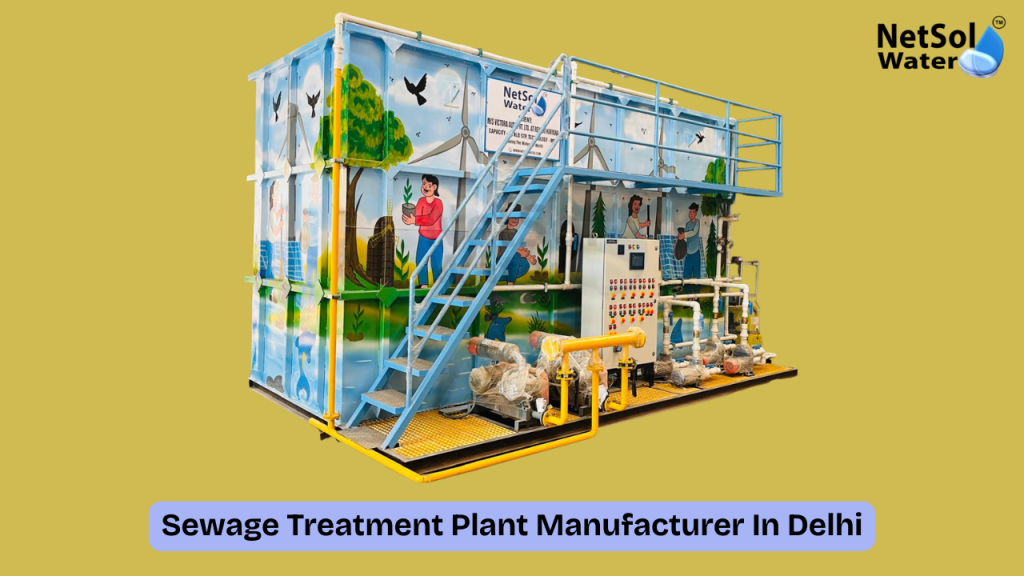
5) Submerged Aerated Fixed Film (SAFF) Technology
Here is a technology that does not always get as much attention as MBBR or MBR, but it absolutely deserves to be in this conversation. Submerged Aerated Fixed Film, or SAFF, is a fixed media biological process that works exceptionally well for smaller to medium scale applications.
The Mechanics of SAFF
In a SAFF system, structured plastic media is fixed within the treatment tank rather than floating freely as in MBBR. Microorganisms colonise this fixed media and form a stable biofilm. Air is supplied through diffusers at the bottom of the tank, which keeps the sewage in contact with the biofilm and provides the oxygen the microorganisms need to break down organic matter.
The fixed nature of the media means there are no moving parts inside the tank whatsoever, which translates directly into very low maintenance requirements.
Practical Benefits Seen By Delhi Users
Several manufacturers in Delhi specialise in SAFF technology for small residential societies, schools, hospitals, and standalone commercial buildings. The compact footprint, low noise, and minimal operational demands make it a genuinely practical choice in urban settings where space and labour are both at a premium.
6) Zero Liquid Discharge (ZLD) Based STP Systems
This is a technology approach that is growing rapidly among industrial clients in Delhi, especially those in sectors like textiles, pharmaceuticals, food processing, and chemicals.
What ZLD Actually Means
Zero Liquid Discharge means exactly what it says. No liquid effluent leaves the facility boundary. All the water that enters the treatment system is recovered for reuse, and only dry solids or concentrate are left to be managed or disposed of. Achieving this requires combining multiple treatment stages including biological treatment, ultrafiltration, reverse osmosis, and evaporation or crystallisation.
Why Industry in Delhi Is Moving Toward ZLD
Regulatory pressure is a big driver. The National Green Tribunal has issued multiple directives requiring industries operating near sensitive water bodies, including those near the Yamuna basin, to adopt ZLD systems. But beyond compliance, there is also a business case. In a water-scarce city like Delhi, recovering and reusing every litre of water actually reduces operational costs over time.
Several manufacturers in Delhi have developed modular ZLD systems that can be integrated with existing STPs, which makes the upgrade path much more financially manageable for smaller industrial units.
Key Factors Delhi Manufacturers Consider When Choosing STP Technology
This is something worth understanding if you are in the process of selecting an STP for your project. Delhi-based manufacturers do not take a one-size-fits-all approach. Here is what typically drives the technology selection:
1) Incoming sewage flow rate and daily volume, because a system designed for 100 KLD cannot be expected to handle 500 KLD without serious problems
2) The quality of the treated water required, with stricter reuse applications needing MBR or ZLD approaches rather than conventional processes
3) Available land area at the site, since compact technologies like MBR or SAFF are often the only viable option in built-up urban Delhi locations
4) Operational skill available at the site, as some technologies require more trained attention than others
5) Capital budget versus long-term operating cost trade-offs, which often favour spending more upfront on efficient technology that costs less to run over ten or fifteen years
6) Sludge handling requirements, since managing and disposing of sludge in a city like Delhi is a real logistical challenge and technologies that minimise sludge production are genuinely advantageous
Understanding these factors is what separates a good STP design from a technically impressive one that simply does not work well in the real world.
About Commercial RO Plant
Since we are talking about the best STP technologies used by manufacturers in Delhi, it would be incomplete not to mention Commercial RO Plant.
Commercial RO Plant is an ISO certified RO Plant Manufacturer and Supplier operating across India. We have built a strong reputation in the water treatment industry by combining solid engineering with a genuine understanding of what clients actually need on the ground. We are not just a supplier of equipment. We are a solutions partner.
At Commercial RO Plant, we work with a wide range of STP technologies including MBBR, SBR, MBR, and SAFF systems, and we tailor every solution to the specific requirements of the project. Whether you are building a new residential township in outer Delhi, upgrading an ageing treatment system in an industrial estate, or setting up a hospital facility that needs consistently high treated water quality, we have the experience and the technical capability to deliver.
Our teams handle everything from design and manufacturing to installation, commissioning, and after-sales service. We believe that a good STP is not just about the technology inside it. It is about how well it is designed, how reliably it is built, and how well it is supported through its operational life. That is the Commercial RO Plant commitment.
Final Steps
After reading through everything above, one thing should be clear. The STP technologies used by sewage treatment plant manufacturers in Delhi have come a very long way, and the options available today are genuinely impressive. Whether your requirement calls for the compactness of MBR, the reliability of SBR, the simplicity of SAFF, or the rigour of a ZLD system, there is a well-proven technology path for your project.
But technology alone does not build a great STP. The manufacturer behind it does.
That is why choosing Commercial RO Plant makes sense. We bring ISO certified quality, nationwide reach, and a track record of delivering STP solutions that actually perform the way they are supposed to, year after year. We understand Delhi's regulatory landscape, we understand the practical constraints of urban projects, and we understand what it takes to treat sewage properly rather than just adequately.
If you are planning an STP project and want to work with a team that brings genuine expertise, transparent communication, and long-term support to the table, reach out to Commercial RO Plant today. Let us help you get this right from day one.


Comments
Post a Comment